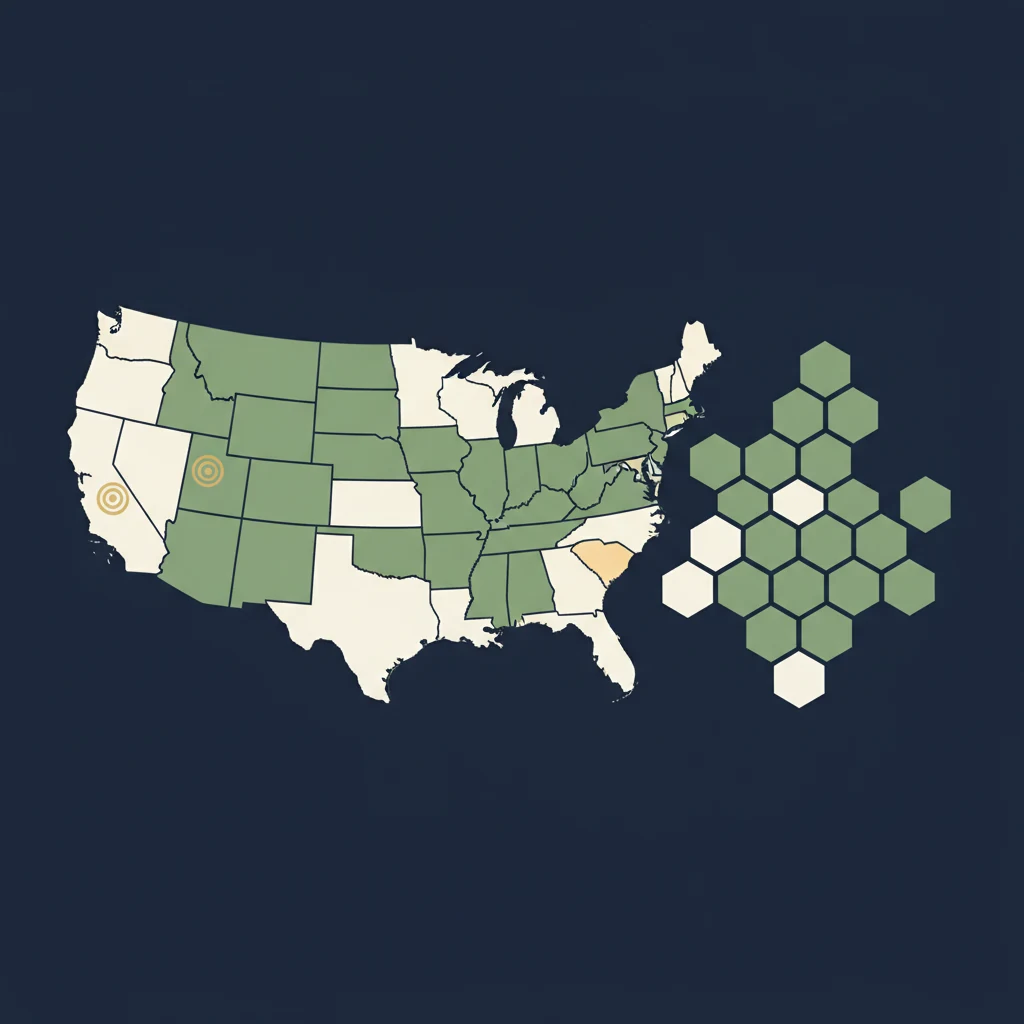
The Program of All-Inclusive Care for the Elderly serves roughly 100,000 older Americans — every one of them certified by a state as needing nursing-home-level care, every one of them still living at home. PACE pays for everything Medicare covers, everything Medicaid covers, and the long list of long-term services in between, under a single capitated payment. National PACE Association figures show 184 PACE organizations operating about 300 centers across 33 states and the District of Columbia as of early 2026. Half of all enrollment is concentrated in California, New York, and Pennsylvania. Seventeen states have no PACE at all.
If that sounds like a quietly enormous Medicaid program most families have never heard of, it is. The reasons it stays small are not accidents — they're built into the structure.
What PACE actually is
PACE is a fully integrated CMS-administered program that bundles Medicare Part A, Part B, Part D, all Medicaid long-term services and supports, and everything in between into one fixed monthly payment per participant. The PACE organization receives that capitation from both Medicare and Medicaid and, in return, takes on the full financial risk for the participant's care. If a member ends up in the hospital, the PACE organization absorbs the cost. If a member needs a wheelchair ramp, dental work, behavioral health, hearing aids, or a nursing home stay, PACE pays.
The delivery model is built around a PACE center — typically an adult day health facility where participants come 2–4 days per week for primary care, therapy, social activity, and meals. An interdisciplinary team of about eleven clinicians (PCP, RN, social worker, physical and occupational therapists, dietitian, home care coordinator, and others) reviews each participant on a rolling basis. Home visits, transportation, and 24/7 on-call coverage are part of the package.
The model dates to On Lok in San Francisco's Chinatown in 1971, became a permanent Medicare and Medicaid benefit under the Balanced Budget Act of 1997, and has expanded slowly and unevenly since. Most growth has happened in the last decade.
Who qualifies — the federal floor
Four eligibility tests apply nationwide:
- Age 55 or older at enrollment.
- Certified by the state Medicaid agency as needing a nursing-home level of care. The state's NH level-of-care assessment is the same one used for institutional Medicaid eligibility — typically requires assistance with multiple activities of daily living or substantial cognitive impairment.
- Resident of a PACE service area. Each PACE organization has a defined catchment, usually a set of counties or ZIP codes around its center. Living one block outside the line disqualifies you.
- Able to live safely in the community with PACE services at the time of enrollment. This is the assessment that decides whether the team thinks PACE can keep you out of a nursing home — not whether you have the resources to stay home on your own.
What is not required: you don't have to be on Medicaid. PACE accepts Medicare-only enrollees, dually-eligible enrollees, and private-pay enrollees. But the economics — and almost all the demand — tilt heavily toward dual-eligibles.
What it costs — and why most participants pay zero
For the roughly 90% of PACE enrollees who are dually eligible for Medicare and Medicaid, out-of-pocket cost is zero. No monthly premium, no copays, no deductibles for in-network care. Medicare and the state's Medicaid program together fund the capitation; the participant pays nothing.
For Medicare-only participants who don't qualify for full Medicaid, PACE charges the Medicaid share as a private-pay premium. That premium is typically $4,500–$7,000 per month, depending on the state and PACE organization. It's an unusual price point — significantly less than skilled nursing facility care (the 2024 national median nursing home semi-private room cost is more than $9,000/month, per Genworth's 2024 Cost of Care Survey as we publish it), but well above what most families pay for traditional home care.
The Medicaid income and asset thresholds that govern dual-eligibility are the same ones that govern institutional Medicaid in most states: roughly $2,982/month in income and $2,000 in countable assets for an individual in 2026, with state variation around medically-needy spend-down provisions, expanded resource allowances, and the standard set of exempt assets (primary residence within the home equity cap, one vehicle, prepaid burial, certain personal property). Our Medicaid spend-down guide walks through the qualification mechanics in detail.
The geography is the binding constraint
The most important fact about PACE is that it is geographically rationed. The 184 PACE organizations have well-defined service areas, and they cover about two-thirds of U.S. states and slightly more than half of U.S. counties. If you don't live in a service area, you cannot enroll, period.
The unevenness is severe. California, New York, and Pennsylvania account for more than half of all PACE enrollment. Massachusetts, North Carolina, Virginia, Michigan, and Texas have meaningful footprints. Seventeen states — including most of the Mountain West and several Plains states — have no PACE organization at all, and seniors there have no path into the program no matter their need or finances.
Two recent moves point in opposite directions:
- California paused new PACE applications and service-area expansions effective November 20, 2025, for a minimum of two years. The state's Department of Health Care Services cited oversight capacity and the need to evaluate program integrity following rapid growth. The freeze applies to new PACE organizations and to expansion of existing ones into new ZIP codes; existing enrollees and existing service areas are unaffected. For Californians outside an existing PACE catchment, this effectively pushes PACE access out of reach until at least late 2027.
- Ohio expanded PACE into new counties in mid-2025 with additional counties slated for early 2026, and CMS issued grants in early 2025 to support PACE development in rural communities. The Veterans Healthcare and Benefits Improvement Act signed in January 2025 also increased veterans' access to PACE programs.
The April 2025 House budget resolution proposed Medicaid funding reductions that the National PACE Association warned could constrain future growth, but those cuts have not been enacted as of this writing. The trajectory line is up, but slowly, and with state-level interruptions like California's pause that can stall expansion in the largest markets.
The trade-offs nobody explains clearly
Most PACE explainers stop at the eligibility list and the "all-inclusive" framing. The structural trade-offs that determine whether PACE will actually feel like a good fit are where families get blindsided.
You give up your doctors
When you enroll in PACE, the PACE organization becomes your sole provider network. Your primary care physician, your specialists, your in-home aide agency, your physical therapist — all of it shifts to PACE staff or PACE-contracted providers. If your trusted PCP isn't part of the PACE network, you don't see them anymore for routine care. Out-of-network services require PACE pre-authorization and are typically only approved for emergencies or specialized care PACE cannot deliver internally. For older adults with decades-long relationships with their providers, this is the most common reason families decline PACE after the eligibility interview.
The day-center model assumes you can travel
PACE is built around the adult day health center. Most participants attend 2–4 days per week for medical care, social activity, and meals. Transportation to and from the center is included. But the model implicitly assumes you can tolerate the trip, the half-day or full-day in the center, and the rhythm of a group setting. For seniors who are deeply homebound, who have severe behavioral expressions of dementia that don't tolerate group environments, or who simply value privacy above structure, the day-center model is a worse fit than a traditional home-health-aide-based arrangement.
The capitation creates real incentives — both directions
Because PACE bears the full financial risk of the participant's care, the organization has a powerful incentive to keep people healthy, out of the hospital, and out of long-stay nursing-home placements. That alignment is the source of PACE's strong outcome data: MACPAC's June 2025 report on PACE and NPA's own data show that 96% of PACE enrollees continue living in the community despite being certified as needing nursing-home-level care, with measurably lower hospitalization and long-stay nursing home admission rates than comparable dual-eligible populations. Participant and family satisfaction figures routinely exceed 95%.
The other side of capitation is that decisions about specialty referrals, durable medical equipment, and elective procedures sit with the PACE team — not the participant. Most of the time this works smoothly; PACE teams are statutorily required to address the full range of medically necessary care. But families occasionally find the interdisciplinary review feels paternalistic, and disputes about whether a particular intervention is needed can produce friction. The federal grievance and appeal process exists, and the disenrollment door is always open, but the trade-off is structural, not occasional.
How PACE compares to a Medicaid HCBS waiver
Many seniors weighing PACE are also considering a state Medicaid Home and Community-Based Services (HCBS) waiver — the more familiar route to home- and community-based long-term care. The structural differences are substantial:
| Feature | PACE | HCBS Waiver |
|---|---|---|
| Payment | Capitated monthly payment to PACE org | Fee-for-service to individual providers |
| Medicare integration | Yes — Medicare and Medicaid bundled | No — Medicaid only; Medicare separate |
| Provider choice | PACE network only | Open — usually any qualified provider |
| Financial risk | PACE org bears full risk | State Medicaid bears risk |
| Waitlist | Rare; capacity gated by service area | Common; waitlists routinely measured in years in many states |
| Hours of care | Whatever the team determines is needed | State-determined caps, often 40 hours/week |
| Geographic availability | 33 states, ~half of counties | Every state, varies by waiver type |
The structural pattern: PACE is more comprehensive but more restrictive on provider choice, and waiver care is more flexible on providers but typically capped on hours and routed through state-administered waiting lists. For a senior whose biggest concern is "I want the most intensive package of services available without a multi-year wait," PACE wins on availability. For a senior whose biggest concern is "I want to keep my own doctor," the waiver route wins.
Should you consider PACE?
Three filters decide whether PACE is worth a serious application:
- Do you (or the family member you're planning for) need nursing-home-level care, but want to stay at home? If care needs haven't reached NH-level — meaning the state's level-of-care assessment wouldn't certify institutional eligibility — PACE won't enroll you regardless of preferences. If care needs have passed NH-level but a nursing home is the assumed default, PACE is the most aggressive community-based alternative on the table.
- Do you live inside a PACE service area? The National PACE Association's "Find a PACE Program" directory at npaonline.org is the canonical map. Type in a ZIP code; if no result appears, PACE isn't an option, full stop. Don't waste time on the eligibility question until geography clears.
- Are you willing to switch to PACE providers — including your primary care doctor? The "give up your PCP" trade-off is the single most common deal-breaker after geography. If keeping an existing provider relationship is non-negotiable, PACE will be the wrong fit no matter what the financial math says.
For dual-eligible seniors who clear all three filters, PACE is, by a wide margin, the most generous Medicaid long-term care benefit available — a fully integrated Medicare+Medicaid package with no out-of-pocket cost, no waitlist, and structural incentives aligned around keeping you out of the nursing home. The reason it stays small isn't that the program is bad. It's that the eligibility, geography, and provider-switch barriers each filter out a meaningful share of the population that would technically qualify.
For families starting the long-term care research process, the right sequence is: confirm Medicaid eligibility (or path to it via spend-down), check whether Medicaid pays for the care setting you want, then check whether PACE exists in your area before defaulting to a traditional nursing home placement or a fee-for-service waiver path. PACE often gets skipped in that sequence purely because nobody mentions it, and not because it would have lost on the merits.
Where to find PACE in your state
The authoritative directory is the National PACE Association's "Find a PACE Program" tool. State Medicaid agencies maintain their own PACE pages with enrollment contacts. For state-by-state context on Medicaid eligibility, asset limits, look-back rules, and how PACE fits into each state's long-term care system, our state Medicaid guides cover the per-state details.
PACE has been around since 1971 and a permanent Medicare-Medicaid benefit since 1997. That it still serves only 100,000 seniors — a small fraction of the population that would technically qualify — is the single clearest signal that the program's barriers are structural, not financial. The economics work. The outcomes are strong. The geography and the provider-switch trade-off are what keep it small.