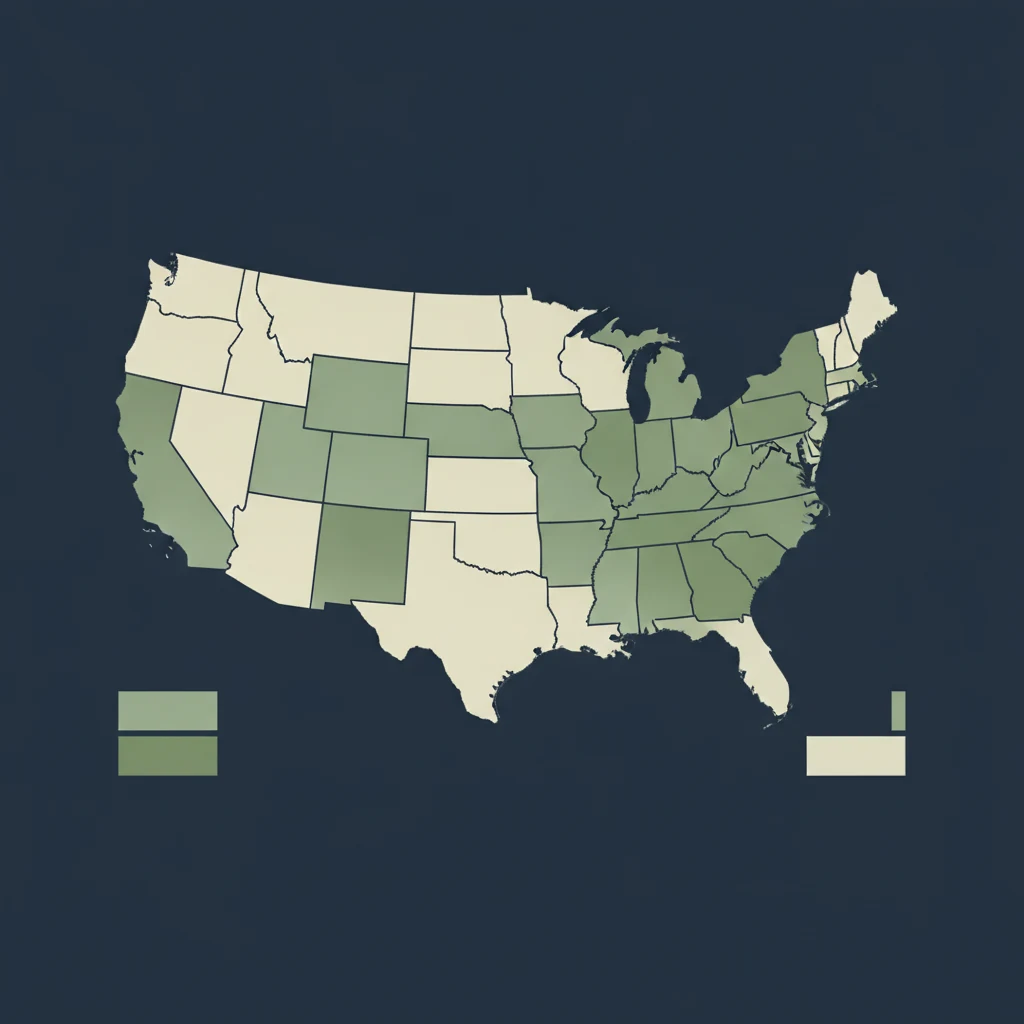
Starting January 1, 2027, a family that applies for nursing-home Medicaid will be able to recover only two months of back coverage instead of three. That single lost month is the difference between the old federal rule and the new one written into the reconciliation law signed in July 2025 (Public Law 119-21). Here is the part almost no one is saying out loud: because that month is measured in nursing-home dollars, the identical federal cut lands as a roughly $5,600 problem in Texas and a $31,000 problem in Alaska. The policy is uniform. The damage is geographic — and it is capped by a set of eligibility conditions most coverage of this change ignores.
This is not a story about a benefit disappearing. Nursing-home Medicaid still exists, still pays, and still covers the overwhelming majority of long-stay residents. It is a story about timing — about how much of a delayed application the program will reach back and pay for, and about a hard filing deadline in December 2026 that quietly decides which rule your family lives under.
What actually changed
Under long-standing federal law, Medicaid could reach back and cover unpaid medical bills for up to three months before the month you filed your application — provided you were eligible during those months. This "retroactive eligibility" existed precisely for long-term care: a parent has a stroke, enters a nursing home, and the family is buried in caregiving logistics for weeks before anyone sits down to file a dense Medicaid application. The three-month window was the backstop for that lag.
Public Law 119-21 shortens the window. The reduction is not the same for everyone:
- Aged, blind, and disabled applicants — the pathway that covers nursing-home residents — go from three months to two months.
- Adults covered under the ACA Medicaid expansion (the working-age, income-based group) go from three months to one month. That group is not the nursing-home population, but it is why you will see the change described two different ways.
The effective date is January 1, 2027, and it creates a filing cliff that rewards acting early. An application filed in December 2026 is still judged under the three-month rule; the same application filed in January 2027 gets two months. For a family already private-paying a nursing home while they assemble paperwork, the calendar page they file on is worth real money. Policy analysts at KFF and elder-law advocates at Justice in Aging have tracked the provision as part of the broader Medicaid changes in the law; the underlying eligibility rules live at Medicaid.gov.
What "retroactive coverage" actually pays — and why the headline number is a ceiling
This is where careful families should slow down, because the scary per-state figures you are about to see are maximum theoretical exposure, not an expected bill. Retroactive Medicaid does not hand you a check for a month of nursing-home care. It only pays for care during a prior month if every eligibility test was already met in that month. Three conditions have to line up:
- You were already financially eligible. Medicaid long-term care has strict asset limits — often just $2,000 in countable assets. Most people are over the limit when a parent first enters care and only qualify after a spend-down. If your parent still held excess assets in the month you are trying to reach back to, that month was never eligible — with or without the retroactive window. The lost month only costs you if you were already impoverished during it.
- You were already medically eligible. The applicant must have needed a nursing-home level of care in that month, documented.
- There was a real bill to reimburse. And even then, Medicaid reimburses the facility at the state Medicaid rate, which is typically lower than the private-pay median — and the resident's own income (Social Security, a pension) is still owed to the facility as a "share of cost." Medicaid only fills the gap above that income.
So the honest framing is this: the reduced window matters most for the family that spent down quickly, qualified early, and simply filed late. For them, losing the third retroactive month can mean personally absorbing a month of care that Medicaid would otherwise have covered. For a family still mid-spend-down, the practical loss is smaller or zero. The dollar figures below are the size of the hole at its deepest — the number to plan against, not the number to expect.
Why the same cut costs more in some states than others
Here is the wrinkle national coverage misses. A "month of retroactive coverage" is not a fixed sum. It is one month of your state's nursing-home cost — and those costs vary more than almost any other number in American health care. Using our own state cost data (built on the Genworth/CareScout Cost of Care Survey; see our methodology), the median semi-private nursing-home room runs $11,040 a month nationally — but the spread is enormous:
| State | Median semi-private nursing home / month | Maximum value of the lost retroactive month |
|---|---|---|
| Texas | $5,639 | ~$5,600 |
| Missouri | $6,548 | ~$6,500 |
| Georgia | $9,086 | ~$9,100 |
| Ohio | $9,305 | ~$9,300 |
| Florida | $10,652 | ~$10,700 |
| California | $12,046 | ~$12,000 |
| New York | $15,164 | ~$15,200 |
| Alaska | $31,282 | ~$31,300 |
A Texas family and an Alaska family lost the exact same thing on paper — one month of federal retroactive coverage. In dollars, the Alaska family lost more than five times as much. That is the geographic disparity a single line in a federal statute quietly created, and it is why "how big a deal is this?" has no national answer. It depends entirely on the price of a bed where your parent lives. For a fuller picture of where your state sits, our state rankings score affordability alongside quality and access.
The states where the 2027 cut changes nothing
Before you mark the calendar, check whether your state already moved. Retroactive eligibility has never been fully uniform: several states obtained Section 1115 waivers years ago that shortened or eliminated the three-month window, and they did not all treat long-term-care applicants the same way.
States where retroactive coverage for nursing-home applicants is already gone or nearly gone. Families in these states have effectively been living under a stricter regime for years, so the federal cut is not new pain — it is the status quo:
- Florida eliminated the three-month retroactive period for most adult applicants, and that includes the long-term-care population — coverage generally begins the first day of the application month.
- Arizona, Iowa, Indiana, and Tennessee similarly restrict retroactive eligibility for most applicants, including seniors.
- Massachusetts allows only a narrow retroactive window for nursing-home applicants.
States that carved out long-term care — so the 2027 cut is exactly where the change bites. Some states shortened retroactive coverage for the expansion population but deliberately preserved the full three months for the aged and disabled. In these states, nursing-home families keep three months today and drop to two in 2027:
- Georgia eliminated retroactive coverage for some groups but explicitly kept it for the aged, blind, and disabled — so Georgia nursing-home applicants still get three months until the federal change lands. (Georgia's separate CCSP waiver for home- and community-based care is a different program with its own rules.)
- Hawaii preserves three months of retroactive coverage specifically for long-term-care applicants while limiting others to a short window.
- Delaware and New Mexico exempt institutionalized applicants from their retroactive restrictions.
The practical takeaway: this is a change that hits hardest in the roughly forty states still operating under the standard federal rule, plus carve-out states like Georgia and Hawaii where the aged pathway had been protected. If you are in Florida or Arizona, the 2027 headline is old news for your family. Confirm your state's current rule with its Medicaid agency before you rely on any of this — waivers get renewed, amended, and reversed.
What to do before the December 2026 cliff
The response to a shrinking retroactive window is not panic; it is speed and sequencing. Three moves matter:
1. File as soon as the applicant is eligible — don't sit on a completed spend-down.
The old three-month cushion made a late application forgivable. It is becoming less so. Once your parent is genuinely under the asset limit and in a qualifying level of care, a filed application starts protecting coverage from that month forward. If eligibility is already clear and the calendar is near year-end 2026, filing in December rather than January preserves the three-month rule for any prior bills.
2. Understand the difference between "applied" and "approved."
Medicaid applications routinely take weeks or months to process, but an approved application pays back to the application's effective date — the retroactive window is measured from when you filed, not when you were approved. That is why the "Medicaid pending" period is survivable: the coverage catches up. A shorter retroactive window makes filing promptly more important, not the approval speed.
3. Get the spend-down right, because that is where the real money is.
For most families the retroactive month is a rounding error next to the spend-down itself. How your state counts a home, a car, a spouse's assets, and prior gifts dwarfs one month of back coverage. If the estate is large or the situation is messy, a NAELA-member elder-law attorney will save far more than the lost retroactive month is worth. Start with the mechanics in our state Medicaid guides.
Other long-term-care provisions in the law to watch
The retroactive-coverage cut is the change with a firm date and a clear effect on nursing-home families, which is why it anchors this piece. Two other provisions in the same law are worth monitoring but should not drive decisions yet:
- A tightened home-equity limit for long-term-care Medicaid has been reported as part of the law, but the specific cap and effective date are not yet settled in guidance. If your family's plan leans on the home's exempt status, do not assume a number — confirm the current limit with your state Medicaid agency before acting.
- More frequent eligibility redeterminations apply to the ACA expansion (working-age) population, not to the aged long-term-care pathway. For nursing-home families this is largely noise.
Excluding provisions that don't touch the aged pathway is deliberate: the value of a policy site is telling you which changes are yours to worry about. This one — the retroactive window — is yours.
The bottom line
If you are helping a parent toward nursing-home Medicaid and you are anywhere near a completed spend-down as 2026 ends, file before January 1, 2027. It is the cheapest insurance available against a rule that, in the most expensive states, is worth tens of thousands of dollars for a single month. And if you are in a state that already scrapped retroactive coverage, skip the calendar drama entirely — your leverage was always the spend-down, and it still is.