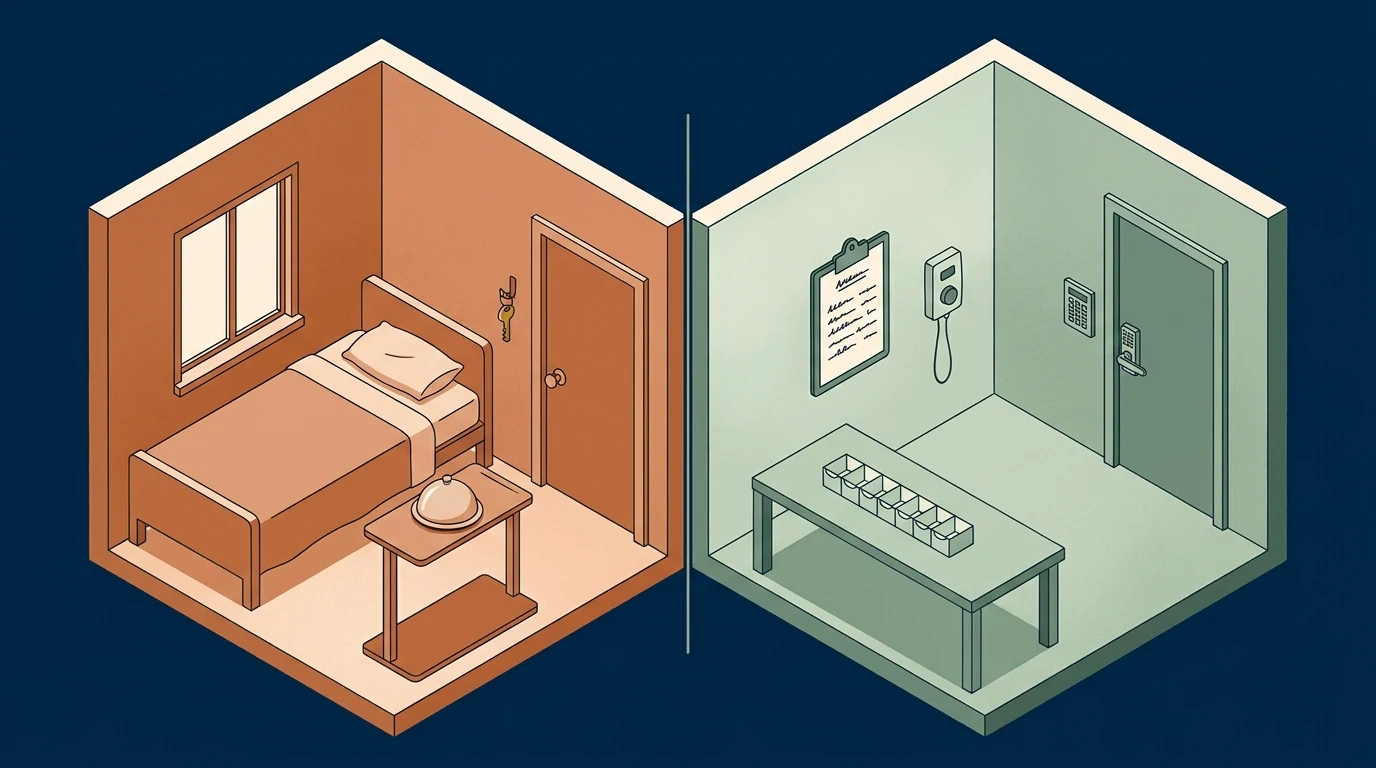
Medicaid does pay for memory care, but in most places it pays for only half of it. In a nursing home, Medicaid covers the whole bill: the room, the meals and the care. In a memory care unit inside an assisted living community, Medicaid can pay for the care, but federal law bars it from paying the rent and the food. That leftover charge comes out of your parent's income, and whatever the income can't cover lands on the family.
This produces a result that surprises most families. On the sticker price, memory care looks like the bargain. Across the state figures behind Elder Care Index's pages, memory care runs about $5,739 a month and a semi-private nursing home room about $11,040. But once a parent with dementia qualifies for Medicaid, the cheaper building can be the one that costs the family money every month, while the more expensive one costs the family nothing.
This post is for the adult child whose parent with dementia is spending down savings, or is already on Medicaid, and who is choosing between a memory care unit and a nursing home bed. It explains where the split comes from, how to work out your family's real monthly number, and which questions decide it.
Why Medicaid splits the memory care bill in two
The split comes from which part of Medicaid is paying. Nursing home care is part of every state's basic Medicaid program, and it is an entitlement: if your parent qualifies financially and medically, the state must pay. The payment covers everything the facility provides, including the bed and the meals.
Memory care in assisted living is paid for a different way, mostly through home and community-based services (HCBS) waivers. Those programs exist to pay for services outside an institution, and the federal rule that governs them is blunt. Under 42 CFR 441.310(a)(2), federal Medicaid money cannot be used for room and board in a waiver program, with narrow exceptions for short respite stays and live-in caregivers. A memory care community's bill therefore gets cut in two: the care charge, which the waiver can pay, and the room-and-board charge, which it cannot.
Medicare does not fill the gap. Medicare does not pay for long-term custodial care, which is what memory care is. It pays for a short skilled nursing stay after a hospital admission, and even that ends quickly, as we covered in what happens on day 101 of a Medicare nursing home stay.
What your parent pays in each setting
In a Medicaid nursing home, your parent's income goes to the facility, minus a small allowance. Medicaid calls the parent's contribution the patient liability, and it is nearly all of their Social Security and pension. Your parent keeps a personal needs allowance for clothes, haircuts and phone bills. The federal minimum is $30 a month under 42 CFR 435.725, and states set their own amount above that, up to about $200. Medicaid pays the rest of the bill, however large it is. The family pays nothing. (The mechanics are in our post on what happens to Social Security in a nursing home.)
In memory care on a waiver, your parent's income has to cover the room and board first. The waiver pays the care charge. Your parent pays the facility's room-and-board charge from their own income, and usually keeps a personal allowance the state sets. If the room-and-board charge is more than the income left after that allowance, someone has to pay the difference, and in practice that means the family. Some states also take a monthly cost share toward the waiver services from income above a set level.
That is the whole mechanism. The nursing home has a ceiling of zero for the family. Memory care has no ceiling at all unless your state sets one.
Your state decides whether the gap exists
States handle the room-and-board problem in very different ways, and this is the variable that decides your family's number. According to KFF's 2025 survey of state Medicaid programs, 41 of the 47 states that responded cover services in assisted living through at least one Medicaid program, and states use tactics such as capping what facilities may charge Medicaid residents for room and board. Broadly, states fall into three groups.
| State approach | What happens to the room-and-board charge | Family's monthly exposure |
|---|---|---|
| Caps the charge | Facilities may charge waiver residents no more than a set amount, usually tied to the SSI benefit. Ohio, Indiana and Washington use caps like this. | Usually none, but fewer facilities take waiver residents |
| No cap, family may supplement | The facility sets the price. Relatives may pay the difference, as Washington allows for upgraded rooms and as several other states allow more broadly. | The gap, every month, for as long as your parent lives there |
| Little or no assisted living coverage | Medicaid pays little or nothing toward memory care in assisted living. | Either full private pay or a move to a nursing home |
Ohio shows how a cap works. Its assisted living waiver limits room and board to the federal SSI benefit minus a $50 personal allowance. With the 2026 SSI federal benefit of $994 a month, that comes to $944. A parent with average Social Security income can pay that from their check. The catch in a cap state is that the facility is taking far less than its private rate, so many communities limit how many waiver residents they accept, or accept none. You trade a money problem for a finding-a-bed problem.
The state Medicaid pages on this site name each state's waiver program. Your state's waiver handbook, or a call to the local Area Agency on Aging, will tell you whether a room-and-board cap applies and whether family supplementation is allowed.
Working out your family's real number
The calculation takes four figures and about five minutes. Ask the memory care community for its room-and-board charge for a Medicaid waiver resident, separate from its care charge. Then take your parent's total monthly income, subtract the personal allowance your state lets them keep, and subtract any cost share. What is left is what your parent can put toward room and board. If the room-and-board charge is higher, the difference is the family's monthly bill.
Here is how that plays out for a parent with the average 2026 retired-worker Social Security benefit of $2,071 a month. The room-and-board charge in the third row is an illustration, not a quoted rate; get the real figure from the facility.
| Setting | Who pays what | Family pays |
|---|---|---|
| Medicaid nursing home | Parent pays about $2,000 (income minus allowance); Medicaid pays the rest of a bill near $11,040 | $0 |
| Memory care, cap state (Ohio-style) | Parent pays $944 room and board; waiver pays care | $0, if you can find a bed |
| Memory care, no cap, $3,200 room and board (illustrative) | Parent pays about $1,970 after a $100 allowance; waiver pays care | About $1,230 a month |
At that rate the family pays about $14,800 a year, and memory care stays are often measured in years. That is the number to set against whatever memory care offers your parent that a nursing home does not. Often there is real value there: smaller units, staff trained in dementia, a secured garden, a calmer floor. The point is not that memory care is the wrong choice. It is that the choice has a price, and families usually discover it after the move rather than before.
Five questions that decide it
Does the community accept Medicaid waiver residents at all? Many memory care communities are private-pay only. If yours is, the waiver math never applies, and a parent who runs out of money there will have to move. Ask before move-in, not when the savings run low. Our guide to finding a facility that accepts Medicaid covers what to ask.
If it does, is there a private-pay period first? Some communities admit Medicaid residents only after a stretch of private pay, or hold a limited number of Medicaid slots. Get the policy in writing, including what happens if no slot is open when your parent's money runs out.
Is there a waiting list for the waiver? A nursing home bed through Medicaid has no waiting list once your parent qualifies; waiver slots can. KFF's October 2026 count found almost 650,000 people on HCBS waiting or interest lists. Not all of them are seniors, and some states have no list at all, but in a state with a long list, "memory care on Medicaid" can mean memory care on private pay for a year or more. See our state-by-state look at waiver waitlists.
Does your parent meet the medical test? Both routes generally require a nursing-facility level of care. Under 42 CFR 441.301, waiver services go to people who would otherwise need institutional care. Dementia often meets that test because of the supervision it requires, but states assess it differently, and a parent in early-stage dementia may not yet qualify for either.
Is there a spouse at home? If your other parent still lives in the family home, the spousal impoverishment rules protect part of the couple's income and assets in both settings. The arithmetic above changes, and it is worth an hour with an elder law attorney before choosing.
When the nursing home is the smarter Medicaid move
For some families the honest answer is that a nursing home is the better fit once Medicaid is paying. That tends to be true when dementia has advanced to the point of needing help with most daily activities, when there are medical needs on top of the dementia, or when the room-and-board gap would drain a family that cannot sustain it. A good nursing home with a dedicated dementia unit gives many of the same protections as memory care, and the family's bill is zero. Our guide to reading nursing home ratings helps separate the good ones from the rest.
Memory care tends to be the better Medicaid move in cap states where you can secure a waiver bed, in earlier stages of dementia when a nursing home would be more restrictive than your parent needs, or when the family can carry the gap comfortably and values what the setting offers.
Before choosing, compare the private-pay prices in your state using our memory care cost by state guide and nursing home cost by state guide, and plan the spend-down with our post on Medicaid spend-down rules by state. For the wider set of payment options, including long-term care insurance and VA benefits, see how to pay for assisted living; most of it applies to memory care too.
The single most useful thing to do this week is to ask the memory care community one question in writing: "What will you charge my parent for room and board each month once Medicaid is paying for care?" That answer, set against your parent's income, tells you what Medicaid will and won't cover.
Frequently asked questions
Will Medicaid pay for memory care if my parent is still in private-pay memory care when the money runs out?
Only if the community accepts Medicaid waiver residents and a waiver slot is open in your state. If the community is private-pay only, your parent will need to move, either to a community that takes the waiver or to a Medicaid nursing home. Apply for Medicaid a few months before the money runs out, since applications take time.
Can we pay the memory care community directly to make up the difference?
It depends on your state. Some states allow family members to pay a supplement toward room and board or a nicer room; others restrict it, especially in cap states. Payments made straight to your parent rather than to the facility can count as income and affect eligibility, so pay the facility directly and confirm the rule with your state Medicaid office first.
Does Medicaid pay for memory care in a nursing home's dementia unit?
Yes. A dementia or memory care unit inside a licensed nursing home is paid like any other nursing home bed, room and board included, as long as the facility participates in Medicaid and your parent qualifies.
Is the room-and-board gap the same in every memory care community in a state?
No. In a state without a cap, each community sets its own room-and-board charge, so the family's gap varies from building to building. That is why the number to ask for is the specific charge for a Medicaid resident at the community you are considering.
Sources
- 42 CFR 441.310, limits on federal payment for HCBS waiver services (room and board)
- 42 CFR 435.725, post-eligibility treatment of income for institutionalized individuals
- 42 CFR 441.301, HCBS waiver requirements (institutional level of care)
- KFF, What Services Does Medicaid Cover in Assisted Living Facilities? (March 2025)
- KFF, A Look at Waiting Lists for Medicaid HCBS from 2016 to 2026 (October 2026)
- Social Security Administration, 2026 COLA fact sheet
- Medicare.gov, Long-term care coverage
- Cost figures: the state median data behind Elder Care Index's state and guide pages (Genworth Cost of Care Survey 2024 adjusted to 2026, with CareScout).